The Psychology of Quiet Luxury: Why Modern Consumers Seek Invisible Status
> **"Quiet luxury is no longer defined by visibility, but by discernment. In an era of constant exposure, true exclusivity lies in exceptional craftsmanship, timeless design, and the confidence to remain understated. Modern consumers increasingly seek recognition not from the masses, but from those who understand the language of quality."**

Abstract
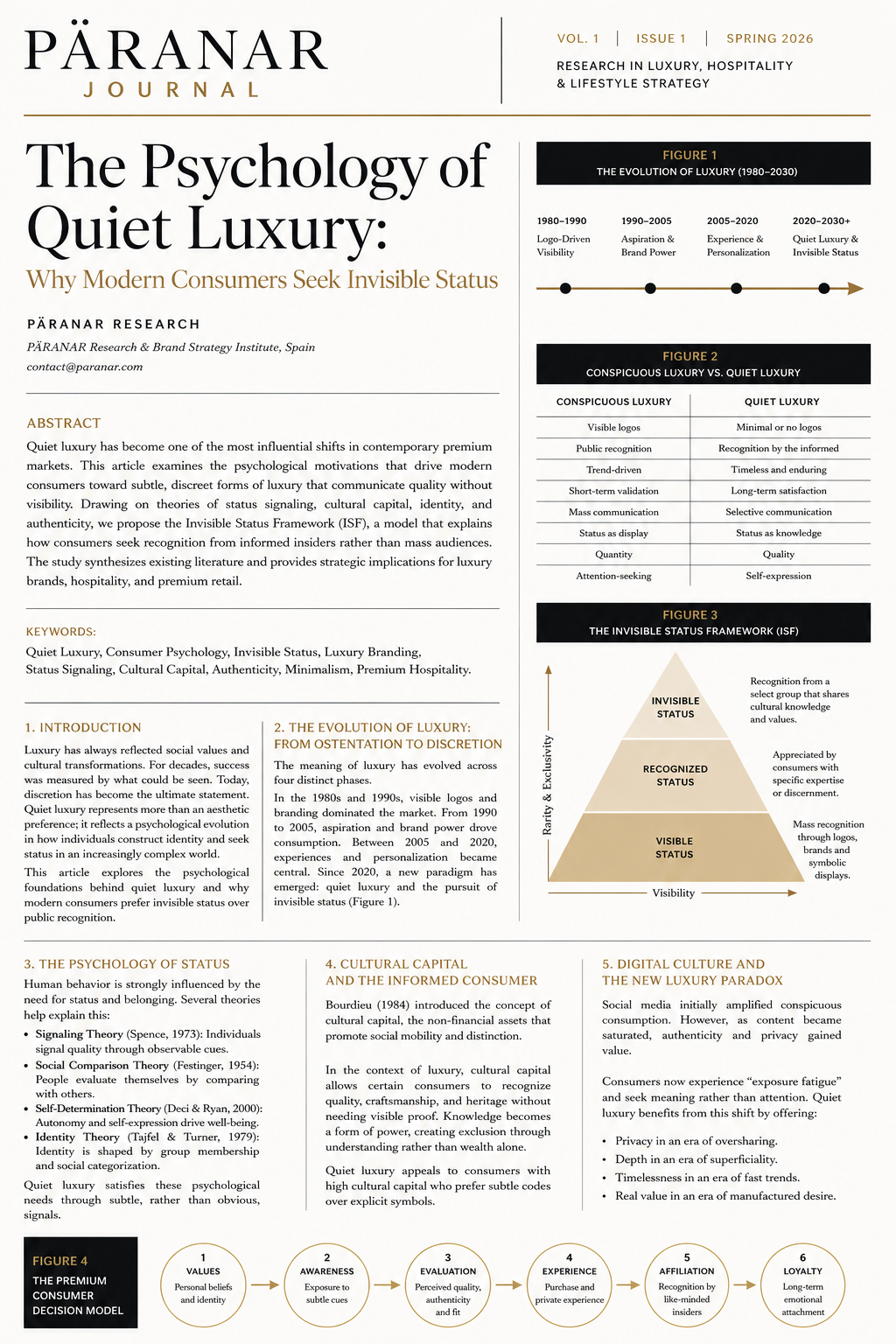
In recent years, the concept of quiet luxury has emerged as one of the most influential trends in the premium market. Unlike traditional luxury, which often relied on visible logos and public recognition, quiet luxury emphasizes exceptional quality, craftsmanship, timeless design, and discretion. This article explores the psychological factors behind this shift, examining how identity, authenticity, and cultural capital have become more valuable than overt displays of wealth. The paper argues that modern consumers increasingly seek «invisible status,» where recognition comes from knowledge rather than visibility.
Keywords: Quiet Luxury, Consumer Psychology, Luxury Branding, Premium Lifestyle, Identity, Status Signaling.
Introduction
Luxury has always reflected social values. Throughout history, expensive goods have served not only practical purposes but also communicated prestige, influence, and belonging. However, the meaning of luxury is changing.
The digital era has transformed how consumers perceive status. Constant exposure to branded products through social media has reduced the exclusivity once associated with visible luxury symbols. As logos become increasingly common, affluent consumers are turning toward products that communicate sophistication without obvious branding.
This evolution has given rise to quiet luxury—a philosophy centered on excellence rather than exhibition.
The Evolution of Luxury Consumption
Traditional luxury was largely based on visibility. Luxury brands invested heavily in recognizable logos, signature patterns, and iconic designs that allowed consumers to demonstrate purchasing power.
Today’s premium consumer often values different characteristics:
- Superior materials.
- Exceptional craftsmanship.
- Timeless aesthetics.
- Functional elegance.
- Limited production.
- Authentic heritage.
Rather than asking, «Can people see what I’m wearing?», modern consumers increasingly ask, «Does this product genuinely represent who I am?»
Identity and Self-Expression
Consumer behavior research consistently shows that purchasing decisions extend beyond functionality. Products become extensions of personal identity.
Quiet luxury appeals to individuals who prioritize internal satisfaction over external validation. These consumers seek products that align with their values rather than social expectations.
For them, exclusivity is not measured by visibility but by rarity, quality, and personal meaning.
Invisible Status
One emerging concept in contemporary luxury is Invisible Status.
Invisible status describes a form of social recognition that depends on cultural knowledge rather than public display.
Unlike conspicuous consumption, where value comes from immediate recognition, invisible status relies on subtle indicators appreciated only by informed observers.
Examples include:
- Exceptional tailoring.
- Hand-finished craftsmanship.
- Rare fabrics.
- Limited production.
- Minimal branding.
- Long product lifespan.
Recognition becomes selective instead of universal.
The Role of Authenticity
Authenticity has become one of the strongest drivers of premium purchasing decisions.
Consumers increasingly reward brands that demonstrate:
- Genuine craftsmanship.
- Transparent production.
- Ethical sourcing.
- Long-term durability.
- Consistent design philosophy.
Luxury is no longer defined solely by price but by perceived integrity.
Minimalism as a Premium Signal
Minimalist aesthetics are often misunderstood as simplicity for its own sake. In reality, minimalism requires precision.
Every material, proportion, texture, and construction detail becomes more noticeable when unnecessary decoration is removed.
As a result, minimalist products frequently communicate confidence and sophistication more effectively than highly decorated alternatives.
Implications for Premium Brands
Brands operating in the luxury segment should recognize that exclusivity increasingly depends on experience rather than visibility.
Successful premium brands tend to focus on:
- Exceptional product quality.
- Consistent visual identity.
- Limited distribution.
- Personalized customer experiences.
- Long-term relationships with clients.
- Timeless rather than seasonal design.
Rather than encouraging consumers to display luxury, these brands enable them to experience it privately.
Future Outlook
As younger generations accumulate purchasing power, demand for authenticity, sustainability, and craftsmanship is likely to continue growing.
Quiet luxury represents more than a passing trend. It reflects a broader cultural movement toward intentional consumption and meaningful ownership.
Premium brands that understand these psychological motivations may be better positioned to create lasting emotional connections with their audiences.
Conclusion
The evolution from conspicuous consumption to quiet luxury illustrates a profound transformation in consumer psychology.
Status is no longer communicated exclusively through visible symbols but increasingly through knowledge, authenticity, and exceptional quality.
In this new landscape, luxury becomes less about attracting attention and more about expressing identity with confidence, discretion, and purpose.
Brands capable of delivering genuine value rather than symbolic excess are likely to define the future of the premium market.